This area covers the village of Chiswell, Chesil Cove and the Esplanade. Close by are the wonderfully evocative Brandy Lane and Pebble Lane.
A few scenes are included here showing the foot of Fortuneswell High Street but the majority of pictures of the Chiswell area - such as Victoria Square - are in the next square north and most pictures of Fortuneswell High Street are in the next area east.
Please click here for a detailed map. Click the BACK button on your browser to return to this page. Please click here to visit the satellite image of this area on Google Maps. Click the BACK button on your browser to return to this page. Please click here to explore this area on Google Street View.
There are a large number of old pictures of this area seen by clicking here.
The village was established through the ancient fishing industry, as the village's location was ideally suited alongside Chesil Beach. It was inhabited during Romano-British times and named "Coesl". The Anglo-Saxon Chronicle reports the village was pillaged by the Vikings during the 8th and 9th centuries. In 789 AD, the first recorded Viking attack within British Isles, including Ireland, occurred on Portland's coast. Although the Vikings' landing place remains uncertain, it is likely that Church Ope Cove was the location. Later Viking raids would have been at Chesil Cove, and attacks by pirates and other marauders followed in succeeding generations.
Over the centuries the village grew, and by the 18th century it had become the largest settlement on the island, with many tradesmen establishing themselves in the area. By this time the residents of Chiswell were mostly made up of fishermen, seafarers or quarrymen. This area has no less than fifteen listed buildings including an old red telephone box at the bottom of Mallams.
We will begin our tour of this area by starting halfway down Fortuneswell High Street where it meets Clovens Road then go down to the bottom of the hill, explore the region around the Esplanade and finally proceed along the Esplanade until we meet the rough path which ends at the Green Hump.
Please use this table to navigate around this page
THE LOWER HIGH STREET [1]
THE UNDERHILL COUNTY JUNIOR SCHOOL [10]
THE HIGH STREET SHOP
THE CAPTAIN’S HOUSE [1]
A LISTED RED TELEPHONE BOX [2]
THE RESTORATION OF THREE DERELICT COTTAGES [1]
MALLAMS [2]
UNITED REFORM CHURCH [3]
THE ASIAN CAFE AT THE FOOT OF HIGH STREET [3]
BRANDY ROW AND BRANDY LANE [4]
FREE PORTLAND NEWS PRINTING WORKS DEMOLISHED [5]
THE ESPLANADE [6]
THE STORM OF JANUARY 2014
PORTLAND'S SEA SCULPTURE BY JOHN MAINE [7]
HALLELUJAH BAY AND HIRAM OTTER [8]
THE GREEN HUMP [9]
FATHER CHRISTMAS DETERRENT
ANOTHER OF MY HOBBIES
THE LOWER HIGH STREET [1]
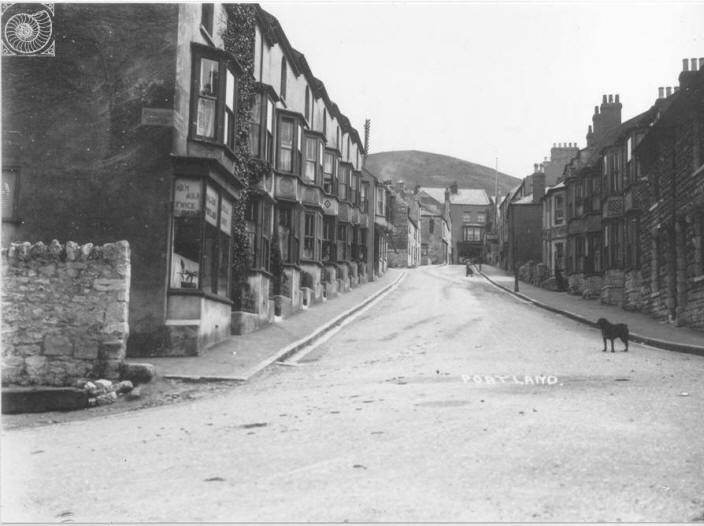
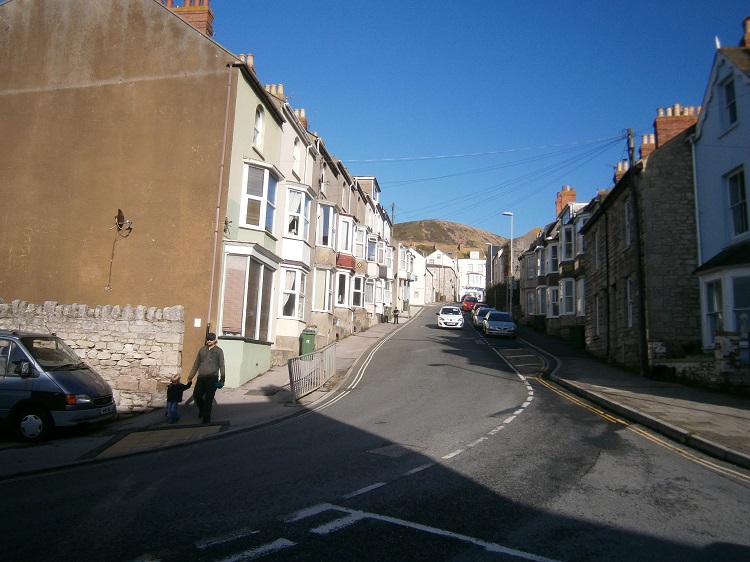
Looking up High Street with Walter Joslin’s dairy and Kilburnie House on left and Simmons the Chemist at the top of the road. This same modern view is shown below.
Diverting up Clovens Road we come to the ‘Council School’ dated 1913. This was built on the edge of the cliff above Chiswell. It became the ‘Underhill County Junior School’. This is now closed and awaiting development.
The site was sold to Bayview Developments Limited and in April 2017 they submitted a planning application to develop the site as twenty-one properties. Planning Permission was granted in November 2017 for twenty dwellings to be created on this school site. The school had been active for 101 years and had achieved high praise for the standard of education in recent years. in November 2007 the school was listed within the top 7% of UK schools for mathematics and ranked in the top 15% for children's progress overall in English, mathematics and science. In 2006 the school was listed in the top 10% for English.
In March 2018 work started to demolish this school to make way for housing.
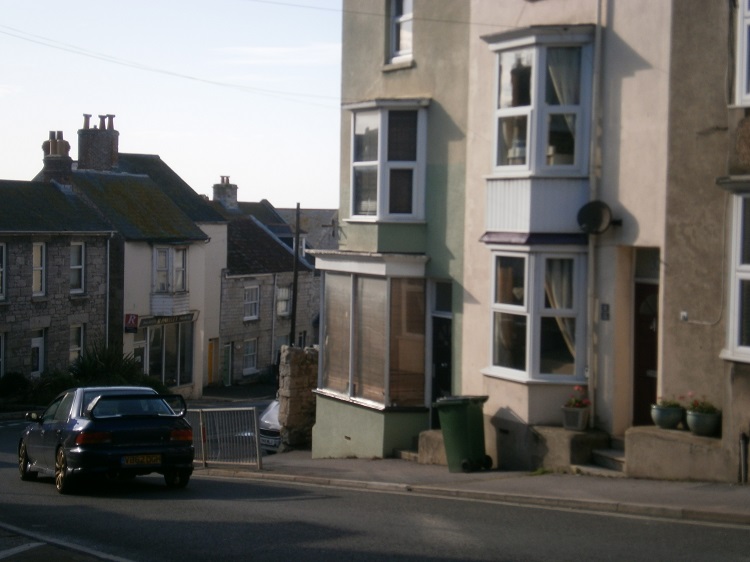
The view further down the High Street looking uphill towards the Clovens Road junction. The shop is on the right edge of the above picture.
Reg Paveley’s tailoring shop was photographed in 2010. It appears on the right-hand edge of the previous picture.
An amusing change for the shop which now offers “Ewenique Furniture” which is presumably sheep orientated judging from the shop window. I’m sure there are lots of baaargins to be found.
Almost opposite Reg’s shop used to be a shoe repair shop. Although I spent many years commuting past it I sadly never photographed it before it closed.
This telephone box at the bottom of Mallams was designated as a Class II Listed Building in 1993. It is a K6 design - I am sure you knew that! - and this made it worth preserving. However, how much longer it will last is doubtful due to vandalism.
Some ancient derelict cottages stood for many years in the lower part of High Street near the junction with Mallams. In the late 1980s these were renovated and converted into very desirable homes as shown below. However, it is a shame that other old stone cottages are disappearing through demolition. They represent a way of life now almost vanished.
The set of photographs below show the renovation of three derelict cottages between 1989 and 2010.
This area around the cottages is known locally as Maiden Well.
Almost opposite these cottages is “The Captain’s House”. This lay derelict for nearly a century but was rebuilt in the late 1990s into a very nice residence. The house has been a Grade II listed building since September 1978.
There is a fascinating account of the possible origins of this house and its recent renovation to be seen here. See also the excellent Wikipedia article here.
There are two stories concerning the history of this unfinished house. One was that it belonged to a sea captain who was building this house for his fiancée. However she died and, in his grief, he left the house unfinished.
The alternative is that it belonged to the notorious Dr Motyer who was a quack exploiting the Portlander's ignorance of medicine. He sold 'cures' for witchcraft and scared the locals around Mallams with unearthly sounds and screams at night.
I published an account of the Captain's House and the reason for its sad state in the Free Portland News, issue dated August 1990. This is reproduced here as a 'true' account of the building.
“Known variously as the 'Doctor's House' or the 'Captain's House', I can now reveal that it was originally owned by the infamous Dr. Motyer whom Stuart Morris describes in his illustrated History of Portland as a quack and a conjuror. Reg Perry has shown me a photograph dating from the mid-1800s which clearly shows the building with a roof. However, it was derelict by the turn of the 19th century.
In fact, Dr Motyer was one of the last alchemists who worked to turn iron and lead into gold. He was feared by all who lived close by because of his weird chemical experiments.
One fateful night in March 1868, residents of Underhill were shaken from their beds by a fantastic explosion. They ran out in their night attire to see the old doctor's house blown to bits. The roof was totally gone and only a few cracked walls were left standing.
By the light of the following dawn a fantastic sight was seen by locals. The fatal explosion must have culminated in the doctor's alchemical success since the entire area around Artist's Row, Mallams and Kings Street was speckled with gold.
There were chaotic scenes as the locals dug and sieved every square inch of their gardens. It was like the Klondike with small pouches of gold dust being legal tender at the old Sun Inn in Fortuneswell. Locals kept this affair a closely guarded secret from strangers - especially those from Tophill - lest there be any ‘claim jumping’.
This is why it has been difficult for me to find the facts surrounding this true story.
The doctor died 'in testate' - hardly surprising in view of the force of the explosion - and so the house had to remain in its present decaying state until a distant relative could be found.”
Remarkably, this wholly fictional story has since appeared as a ‘true’ account as has my other ridiculously untrue story of the origin of ‘Nicodemus Knob’ - click here to see this story.
The many reincarnations of the cafe at the bottom of High Street.
In June 2003 cafe became The Kohinoor Cafe. In 2004 this shop had another change when it became Cafe India and in 2009 it transformed yet again into the Balti.
At the time of writing (March 2018) this is still The Balti.
Looking up Fortuneswell High Street in 2007 from Chiswell. ‘The Crown Inn’ stood on the corner where the grassy area is now seen. This was demolished to enable the road to be made safer.
Below is a picture matching the above view a century ago.
Note the number of shops in this area a century ago.
This view from February 2015 shows what used to be shops next to where the Asian cafe stands. The house with a bay window was an antiques shop in the 1970s.
This building was the United Reform Church and its history is described by Ashley Smith in an informative article which can be read here. It was built in 1825 and extended during the Victorian era. However falling congregation numbers resulted in it closing in 2009. It is now used as a community hall with the school hall and manse being converted to residential use.
The Crown Inn stood on the grassy area to the right.
The Esplanade can be seen between the houses in this late 1980s picture. Brandy Row and Brandy Lane lie behind the Esplanade and are prone to flooding when powerful gales pound Chiswell.
Brandy Row seen from the Esplanade.
We have now reached the old fishing village of Chiswell or, as sometimes known, Chesiltown. The main area of this village is described in the next area north. We will move up onto the Esplanade and turn south towards the path along the foot of the cliffs.
This row of cottages in Brandy Row is a mixture of old and new properties. However, this area was devastated in the ‘Great Storm’ of 22nd November 1824. In all, some eighty houses at Chiswell were completely destroyed by the waves in less than half an hour, whilst countless other buildings sustained considerable damage and almost thirty of the inhabitants perished amidst the turmoil.
Thus, few buildings now standing in Chiswell are from the pre-1824 period.
Another view of Brandy Row as we move south on the Esplanade.
Brandy Row near its junction with the Esplanade. Until the 1980s the garage with its doors open had a faded sign saying that this was the home of the ‘Weymouth Perfume Company’ - an odd business in such a place unless there was a market for perfume made from fish oils?
The next picture is a close-up of the mural.
Above we see the southern end of Chiswell photographed in about 1990 where the road rises to meet the esplanade. In Victorian days this would have looked quite different with unstable fisherman's houses perched on shifting shingle. Even with the modern beach protection provided by The Esplanade, floods sometimes still roar down this road and the houses have sandbags and flood gates ready.
A sturdy house once stood on the point from where I took this picture as shown below.
Imagine a ferocious storm throwing huge waves over the beach causing deep water to pour around and over this house. What was even more dangerous was the lack of foundations these old houses; they stood on the pebbles of the beach. In the Great Storm of 1824 eighty cottages and houses like this were destroyed by the waves with great loss of life - please click here for more about this terrible storm.
The pictures above and below show the ruined buildings at the top of Brandy Row.
They appear now to be a blot on the local landscape. However, go back to Victorian times and this is what you would have seen.
This old photograph shows the cottage at the end of Brandy Row before it was reduced to the sad state shown in the previous photograph.
Another view of the old cottages built close to the brow of Chesil Beach.
In Victorian times and earlier fishermen built their houses on this ridge of pebbles. Could there have been a more precarious place to live? Now the sea is held back - most of the time - by a huge defensive wall. Please click here to see a very dramatic picture taken during the storm of January 2014 showing the sea breaking over the Cove House public house. Another dramatic picture taken during this storm can be seen here. This latter picture was shown on national television and became an icon of the power of the January 2014 storm.
This area of Portland has been savagely attacked by the sea over the centuries and the above cottages were destroyed by storms.
On 23rd of November 1824 there was a 'Great Tempest' which is described here. In Chiswell 36 houses were demolished, 100 rendered uninhabitable, 100 families deprived of their properties and possessions and 25 persons drowned.
This mirror in the Portland Museum was in the upstairs room of a cottage in Chiswell when it got flooded. You can see how the seawater rose one-third of the way up the mirror!
In the book "Big Ope - Little Dreams" by John Matthews published by Artsmiths of Portland in 1990 John described a storm when he was a child that was so severe that waves broke onto the cottage roof and water poured down the chimney and roared out through the house.
The area behind the Esplanade is used to store small boats. However, in stormy weather the sea can pour over the wall and destroy any boats not moved to safety. This picture shows what happened when boats were not moved before a storm struck in 1979.
Brandy Row lies behind this building which was ‘Artsmiths’ printing works. I took this picture a few weeks before a runaway lorry careered down the steep hill from Fortuneswell and smashed into the print shop and destroyed it in the late 1980s. Luckily this part of the building, which was used by the Free Portland News printing press, was unoccupied.
The extension this side of the house has not been rebuilt after the accident - see the view above in April 2010.
Let’s take a walk from the Cove House Inn - see below and featured in the next web page north - southwards along the Esplanade and then follow a rough path to a small cove sometimes popular for barbecue and skinny dipping parties.
During the ferocious storm on January 2014 the sea threw vast quantities of pebbles against the Esplanade. This picture shows how the railings were buckled under the onslaught of stones.
The storm swept away nearly all the pebbles from the Esplanade and exposed the foundations of the sea wall. The sign high up on this face of the defensive sea wall was originally at eye height for walkers on the beach.
This picture taken in 2018 and shows how the beach has largely regenerated; partly by work by the Department of the Environment bulldozers but mostly by the natural action of the sea. Portlanders with long memories were well aware that previous severe storms had stripped away the pebbles only for them to gradually return over the following years.
Two of my grandchildren pose by the base of the defensive sea wall which has been undermined by the January 2014 storm. The removal of the pebbles exposed the underlying clay which forms the base of the whole Chesil Beach.
One effect of this violent storm stripping away the pebbles was the revealing of rusting steel which had lain for decades buried under many metres of stones. This was probably a part of the SS PREVEZA which ran ashore where the Esplanade now stands on 15th January 1920.
The picture below shows this wreck on the beach. It broke up and much of the ship probably remains buried in the clay under the stones of Chesil Beach.
Please click here for more pictures of this shipwreck.
Moving on southwards on the Esplanade we come to ‘Quiddles’ - please click here for details - where a drink, meal or just an ice cream can be bought. The picture below shows the small toilet block that existed before ‘Quiddles’ was built.
Notice how high the pebbles are up the sea wall compared with the above pictures taken immediately after the January 2014 storm.
This picture from the early 1990s shows the public toilets at the bottom of the picture. These were demolished and Quiddles Restaurant now stands on that site.
The last part of the curving Esplanade passes the sculpture by John Maine. Many Portlanders thought they would never see this sculpture completed. It was commissioned in 1988 and took six years and £250,000 to complete. It consists of five low walls representing the relationship of the sea and the coastline with each wall representing a different strata of rock. There is a very informative article by Ashley Smith describing this monument - please click here.
It has been highly praised internationally and is seen above during construction in around 1990 and below when completed in all its glory. The project was funded by ARC Southern, The Elephant Trust, The Henry Moore Foundation, South West Arts, Weymouth & Portland Borough Council, The European Year of the Environment, Dorset County Council, the Chesil Gallery and a number of private individuals. There is a video describing the monument; its planning, construction and the awards it has won which can be viewed here.
The picture below shows this area before the Esplanade was built.
Please click here for more old pictures showing this area before the Esplanade was built.
At the end of the concrete Esplanade is a rough path which goes for about one kilometre; weaving its way through landslips and stone scree slopes left by centuries of quarrying.
This area is known as Hallelujah Bay (or variants of that spelling) - please click here for details of this area and how it got its name.
This path was cleared almost single-handedly by Hiram Otter, one of Portland’s many eccentrics.
Hiram Otter (1833 - 1915) with his umbrella painted with religious slogans.
Hiram Otter is third from left in the back row in this picture from 1900. Beards were all the rage in those long past days. He would carve biblical inscriptions and first lines of hymns onto the boulders and would then cry "Alleluia!" when each text was completed.
About ten years ago I discovered the above faint lettering on a rock in the area. It is said that none of Hiram Otter’s carved texts have survived but - could this be one? Is that partial misspelt word part of Jesu Joy Of Man’s Desiring?
The sun was at a fairly high angle so I determined to return when the sun would be at a glancing angle and show up the faint letters better. So a few weeks later I returned and found this!
Oh well - now I will never know whether Hiram Otter’s last surviving religious text existed at this spot.
In 2016 the mystery of this rock carving deepened when I discovered that Naomi’s name had been deleted and a retrospective date had been added.
The following pictures show the rough terrain through which Hiram Otter’s path passes. The cliffs of West Weares tower over the walker.
There is a bunny in this picture. Can you see it?
Twenty years ago the path went where my best friend Sandy is standing but it has long been diverted to avoid landslides.
This picture shows how a tarmac section of this path became nearly vertical in 1990 as a result of a large landslip in the unstable scree slopes.
The diverted path is to the left of the broken path in this picture.
This was once a flight of steps with a handrail. Recent landslides have made this impassable.
Most walkers will have given up by this point because of the dangerous and near-vertical climbs.
If you persist in following this path it comes, after a great deal of hand-over-hand scrambling to what is known locally as “The Green Hump”.
Beyond the “Green Hump” the foreshore is very difficult and dangerous to walk upon.
The southernmost point of the “Green Hump” shows the steeply inclined rock strata exposed by coastal erosion. The cliffs of Blacknor Point are in the background.
In this area and elsewhere on Portland we see a lot of these wire mesh cages placed over chimneys. These are ‘Father Christmas’ deterrents placed there to prevent the old guy coming down the chimney on Christmas Eve and delivering inappropriate presents such as addictive computer games, loud musical instruments, unhealthy sweets and craft activities that create a terrible sticky mess which parents have to clear up.
Age of 75 I started a new hobby - writing and publishing books. These are available as paperbacks from Amazon - please click here for details. Their overall star rating from readers is
Keywords Chesil Chiswell Esplanade Cove House Inn storms Quiddles January 2014 Brandy Row Free Portland News Hallelujah Bay and Hiram Otter Portland Dorset